

How to Make a 12-Month Story Driven Content Plan (in 30 minutes)


On my business journey, I’ve learned that content creation makes me feel one of two ways.
It either makes me feel drained, or, like I’m sharing a gift with the world.
Today, I want you give you a simple, powerful process that allows you to share your gift with the world. By the end of this article, you’ll be able to map 12-months of story driven content, in less than 30-minutes.
In 2011, when I first started designing content (gosh I’m getting old 😂), I fell into the trap of trying to “convince” people to explore my offers, and I know I’m not the only one…
I started by:
❌ Learning on Youtube
❌ Making a buyer persona
❌ Outlining the persona’s pain points
❌ Then, designing content around those two things.
Even though it was somewhat effective, I faced a problem, I felt like I had no voice. My content didn’t feel like me, it felt like a chore. I was just churning “how-to” content to try and get clicks.
It didn’t feel like “me.”
At the end of the day, if what you’re sharing doesn’t feel aligned with your voice and mission, you’ll stop doing it…AND your audience will feel your lack of enthusiasm.
Don’t get me wrong, buyer personas and pain points are very important, but they should NOT be the starting point of your content.
Content creation is a delicate art form that requires several articles, so today we’re going to focus on one of the first, and most important stages of the creation process:
Content Mapping.
Having your content mapped out ahead of time will help you in multiple ways.
Doing this properly will help you:
✅ Effortlessly create topics that are unique to your brand
✅ Invite your audience to join you on a transformational journey
✅ Provide an idea bank you can source from all year long (YES!)
✅ Position yourself in a way that sets you apart
Before we dive in, I want to note:
There are a few foundational elements you should have in place first to ensure success. I won’t be covering them here, but they will be in future editions of this newsletter.
Here’s the short list of what you should have (ideally, but not required for today):
A brand messaging book (Example of what a high end book includes)
A strong understanding of your business, and clarity on your offers
A decent understanding of your audience: where they are right now, and where they want to get to. (this will be needed today)
These things don’t need to be fancy, progress is better than perfection. Even a 1-2 page Google Doc will do. These elements will help you create a cohesive, timeless, message everywhere.
People don’t just buy based on information. They’re drawn to presence, values, emotion, and energy. Information or “content” is how the mind justifies what their emotions are telling them to do.
Fun fact: 80% of the signals between brain and body flow from the body to the brain — via the vagus nerve.
You can observe this on an individual level, not just business.
For example, if you go to a dinner with 10 people you’ve never met, you might instantly vibe with just a few of them. without much dialogue. Why? Because you share unspoken values, styles, energy, or subtle cultural overlaps. It’s rarely what they say that draws you in first—it’s how they feel.
People are drawn to presence, authenticity, and truth.
The framework I’m sharing today will extract content that is sourced from your truth, your beliefs, values, approach, and perspective.
Not:
❌ What keywords people are searching on google
❌ What ChatGPT spit back from a prompt
❌ What your competitors are posting about
The first step to stellar content, is the source, and it needs to be you. In a future article I’ll be sharing how you can communicate and polish your truth into formats that make it keyword friendly, or similar to competitors, but the seed of content must start with you.
That is today’s focus.
I’ve provided exercises and walkthroughs throughout the article as well.
Our Goal Today
To help you create a 12-month story driven content map based entirely on your unique perspective, values, and the transformation you help your customer achieve.
When you’re mentally stuck, dry on ideas, or just tired of forcing it—this map will give you something rooted and reliable to come back to. And it’ll actually reflect your voice, not someone else's trends. You could even do this for each of your products, not just your business.
You’ll make content with a different kind of energy, one of giving, abundance, and expression. People will feel your presence because of it.
Step 1: Define Their Transformation
For this entire process, pretend you’re writing a book, or designing a course for your ideal customer. We need to get clear on two things:
Where is your customer right now?
Where do they want to go?
Where are they now
What is the core problem they are currently facing? It’s often an internal and external dilemma. Let’s pretend I’m a holistic health coach.
My client’s might be suffering:
Health complications from being overweight (external)
Lack of health knowledge (external / internal)
Low confidence (internal)
Feeling disempowered (internal)
Now let’s write these into a core problem that combines both the internal and external obstacles they are facing.
“My customer is currently stuck in an overweight body that’s taking a toll on their confidence, and personal power.”
Where are they trying to go?
Now, let’s determine what they want.
❌ Not what you want.
❌ Not what your product does.
What they actually want.
People don’t want your offer—they want the outcome your offer helps them achieve.
Those holistic health clients don’t really want “a coach.”
They want an outcome the coach helps them achieve.
They really want to:
Live longer
Show up better in their relationships
Regain energy and confidence
Feel strong, clear, and capable again
That’s the transformation you help them achieve.
If your business sells multiple things, there is still one core transformation that everything ladders back to. Find that.
Now, lets turn it into an outcome driven statement your product/offers help them reach.
“We help our customers achieve more energy, confidence, and physical health through 1-on-1 holistic coaching.”
⭐️ This is the north star of your content map.
Put it into action:
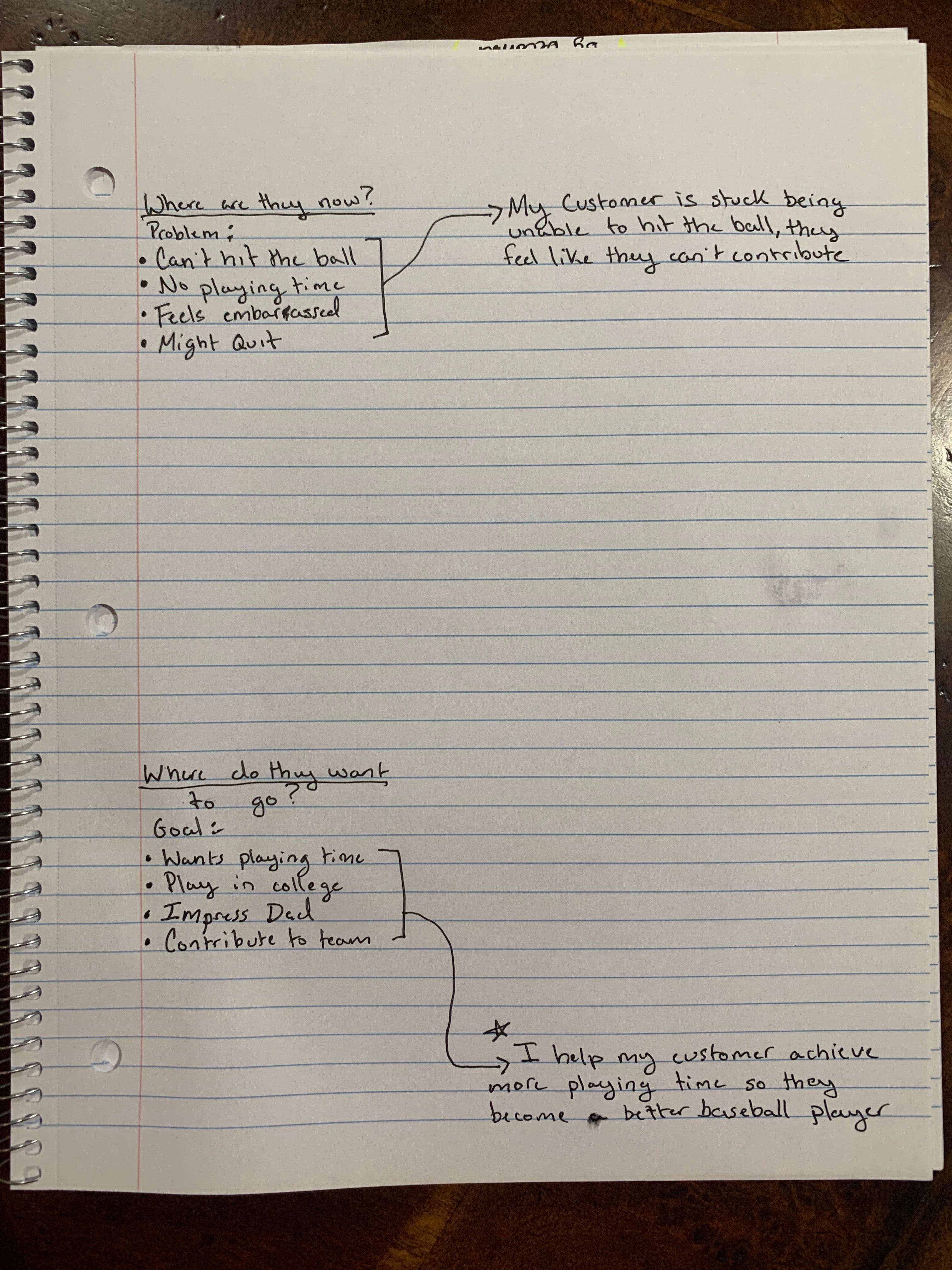
Grab a blank piece of notebook paper (Google doc works better), and draw a diagram like the one below. Then, fill it in. Don’t spend more than 5 minutes on this. Click the ambience to help you focus, when it stops your time is up.
(I’ll do this with you as if I’m a batting coach for baseball players)
Once complete, move onto step two.
Start your timer:
Step 2: Close the Gap (From Your Perspective)
It’s time to map out the journey that YOU believe your customer needs to go through to get there. This is where your expertise comes in. Your philosophy. Your lived experience. Keep this raw, don’t filter it. These are YOUR beliefs, and YOUR perspectives.
Grab a pen and write down 6–12 major milestones or doorways someone would need to walk through to reach their transformation. You can use a mix of internal and external doorways here. Think of these as the steps they need to take to get to their goal. It’s best if you list them in a sequential order. These should be tied directly to the support or services you provide.
Let’s say you’re a yoga teacher. Your major milestones might be:
Learning the fundamentals of yoga
Understand how to build good habits
Learn basic exercises
Implementing mindfulness practices
Advanced & intermediate movements
Build self-discipline and consistency
Practice self-love and emotional care
(I’m not a yogi so these might not be accurate)
This will work best if you can map 12 doorways, but you don’t need to reach that number. Just list the big ones that feel you feel are essential.
Don’t censor yourself here. If you believe someone needs something that goes against the status quo of your industry, include that, that will be gold later on. It will set you apart from people parroting industry jargon, but don’t force it, let it arise naturally if applicable.
Put it into action:
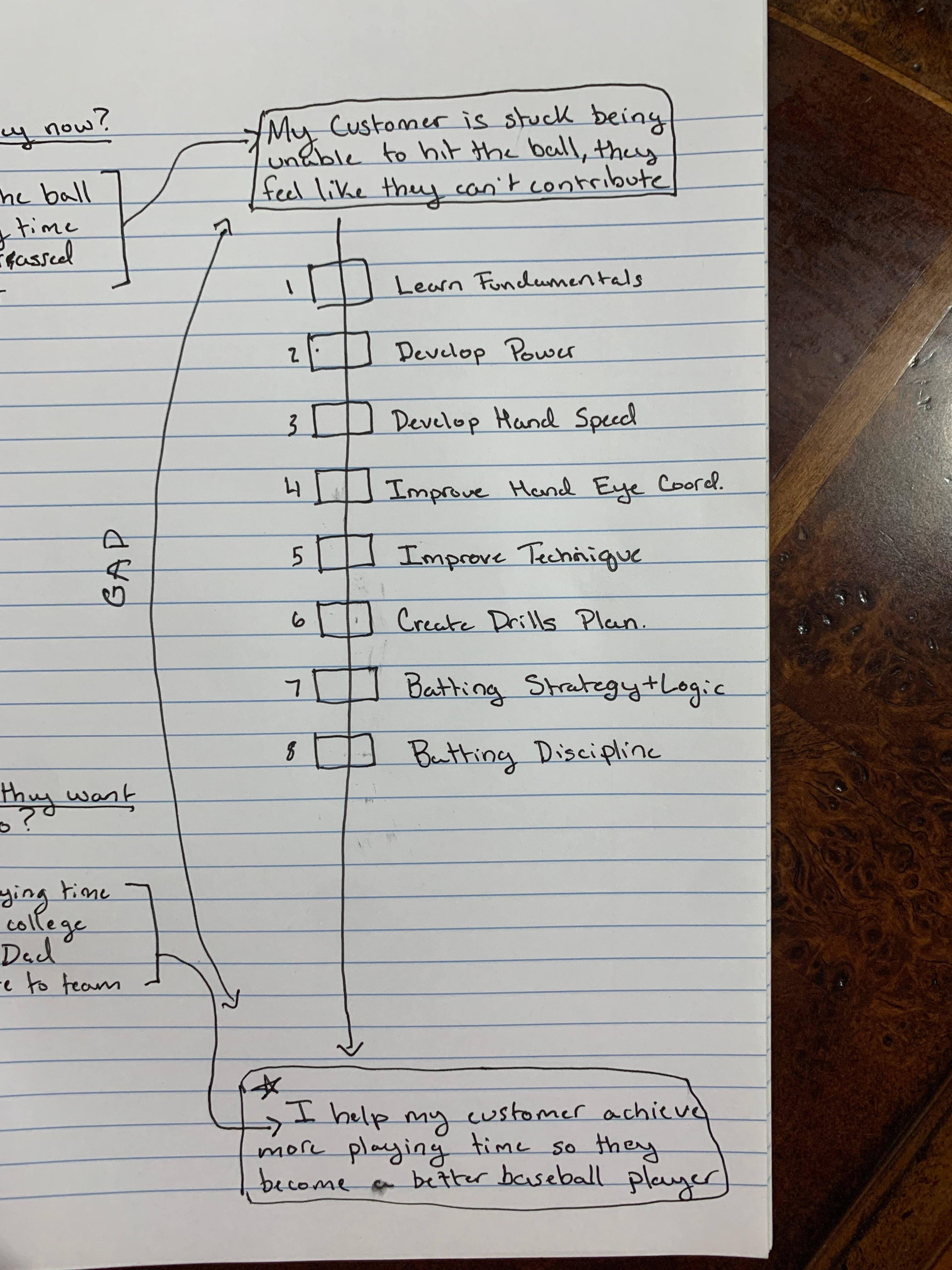
On that same piece of paper, draw twelve doorways (circles) like the one below. Then, fill them in. Don’t spend more than 10 minutes on this. Click the ambience to help you focus, when it stops your time is up.
Note: I mentioned earlier to pretend you’re outlining a book, pretend that’s what you’re doing here. If your customer sat in front of you right now and said “Hey, I’m stuck in this situation, I want to reach this goal, what’s my path to get there?”
What would you tell them?
Once complete, move onto step three. (I only did 8 because I ran out of space)
Start your timer:
Step 3: Break Each Doorway Into Subtopics
Now for each doorway you listed, you’re going to break it down one step further. Make subtopics that are relevant to each doorway. You can make as many as you want for each, I recommend a minimum of 5 for each. You don’t need to polish these for titles. Just write the ideas raw and unfiltered. Just like before, keep this true to YOUR perspective and unique life experience. The things you know to be true that your audience needs to hear.
Example:
Yoga Doorway #1: Learn the Fundamentals
Subtopics:
What Yoga Really Is
How to Breathe
The Big 5 Poses
Implementing a 5-Minute Personal Practice
Letting Go of Performance
Let’s put it into action:
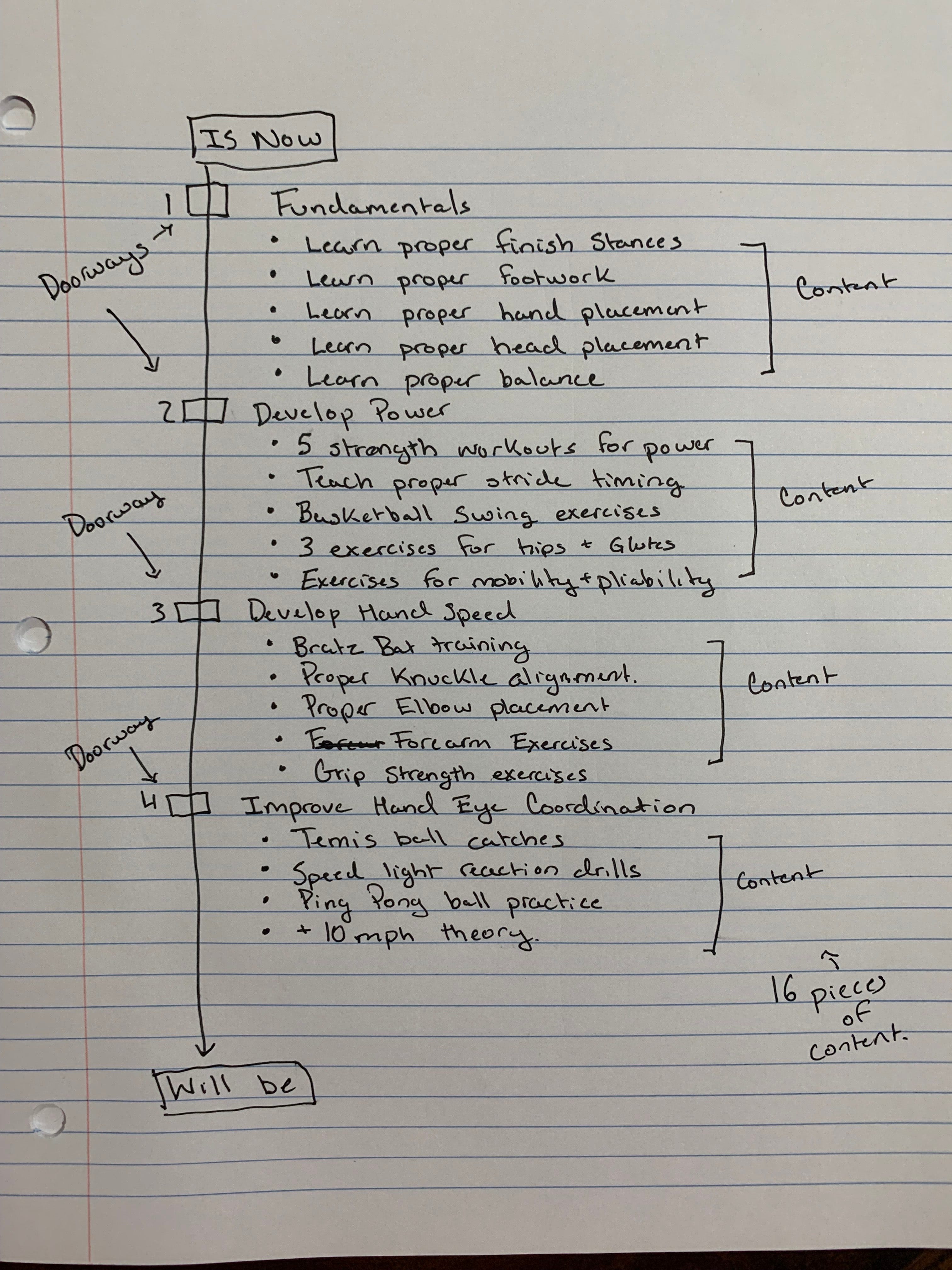
On that same piece of paper, draw twelve doorways like the one below. Then, fill them in. Don’t spend more than 20 minutes on this. Click the ambience to help you focus, when it stops your time is up.
Once complete, go to next step.
(I only did 4 of the doorways because I ran out of space, I recommend using a google doc…)
Start your timer:
You Now Have a Content Map Sourced From YOU.
That’s it, this is your map for content.
You just:
✅ Outlined a gift to your audience.
✅ Made a story driven content map (very powerful)
✅ Defined your customers core problem
✅ Defined your customers core goal
✅ Designed a transformational journey (you could turn this into courses, products, or books)
✅ Made 12 content categories you talk about (your doorways)
✅ Made 96 ideas for pieces of content (12 categories x 8 subtopics each) that don’t energetically “box” you in
Most people just slap content together based consumer pain points, or they talk to their audience without resonance. Or, they feel like their isn’t “them.” This solves that problem. This process will allow you to speak from a place of presence, not from a place of trying to convince people. You’ll be sharing your personal connection to your craft. In future editions, I’ll share how you can turn your subtopics into elite pieces of content.
Next Steps
You may already have a name for this whole transformational journey, but if you don’t, I recommend naming it.
For example, I offer a 90-Day Reset for business owners who feel overwhelmed and stuck. But, instead of calling it a “90-Day Reset” which isn’t bad. I call it “Rhythm90” That name has more flavor. I recommend naming yours something unique if possible, even if it’s only for internal purposes. This will help you on client calls. When you can say I created the “XYZ” program, it comes off more powerful. (and makes it easier for their brain to process!)
👉 Download my FREE notion content planner
If you need an effective way to store ALL your ideas and content efforts, check out my notion content planner. I use it to manage content planning for all of my clients. I’ve included a video walkthrough for you as well once you download it.
🛑 Don’t let your content map sit and collect dust, put it somewhere you’ll see or use it frequently. You don’t need to follow it religiously. Use it as a guiding source that you can add and drop things from over time. It’s okay to deviate sometimes, as long as it makes sense.
Coming Next Week…
Next week, I’ll show you how to take these raw ideas and start turning them into elite pieces of content—things people want to read, save, and share….NOT things that just take up feed space.
If you get stuck anywhere while doing this, please comment below, or reply to this email.
Stay centered,
Gio
🙏
P.S.— Wherever you are on your journey, be patient. Keep going. You’ve got this.
Thanks for sharing, I appreciate